Language Technologies and Digital Humanities (JT-DH) 2026 Template
作者:
Tina Munda, Jakob Lenardič, Timotej Knez
最近上传:
7 个月前
许可:
Creative Commons CC BY 4.0
摘要:
The official template for the JTDH 2026 conference. https://www.sdjt.si/wp/jtdh-2026-en/
The official template for the JTDH 2026 conference. https://www.sdjt.si/wp/jtdh-2026-en/
% The template needs to be compiled using pdfLaTeX

\documentclass{article}
\usepackage{jtdh}
% \definecolor{Mycolor2}{HTML}{00F9DE}
%\usepackage[utf8]{inputenc} % allow utf-8 input
\usepackage[english]{babel} % Change to slovene if slovene paper
\usepackage{url}   % simple URL typesetting
%\AtBeginDocument{\urlstyle{APACsame}}
\usepackage[hang,flushmargin]{footmisc} % no indentation in footnotes
\usepackage{hyperref}
\hypersetup{colorlinks = true, linkcolor = black, urlcolor = gray, citecolor = black, anchorcolor = black}
\usepackage{booktabs}       % professional-quality tables
\usepackage{amsfonts}       % blackboard math symbols
\usepackage{nicefrac}       % compact symbols for 1/2, etc.
\usepackage{xcolor}
\usepackage{graphicx}
\usepackage{tabularx}
\usepackage[backend=biber, style=apa, uniquelist=false]{biblatex}
\addbibresource{references.bib}

\usepackage[]{langsci-gb4e}  %for glossed examples
\let\eachwordone=\sffamily %or \normalfont
\let\eachwordtwo=\sffamily


\usepackage{enumitem}
\graphicspath{{img/}}
% table styles
\aboverulesep=0ex
\belowrulesep=0ex
%\AtBeginDocument{%
 %  \renewcommand{\BRetrievedFrom}{}
%}% Websites; note the space.

%\addbibresource{references.bib} %Imports bibliography file

\title{Title of the paper}

\author{
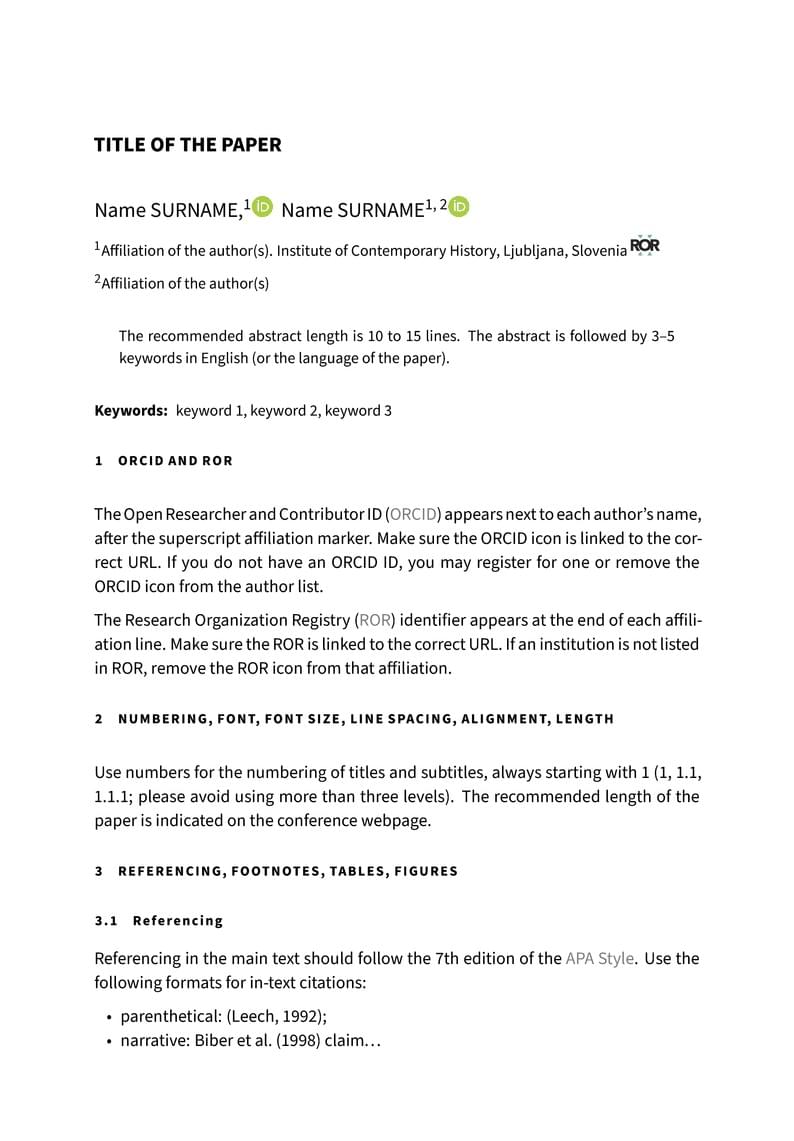
  Name SURNAME,\textsuperscript{1}\orcidlink{0000-0000-0000-0000} Name SURNAME\textsuperscript{1, 2}\orcidlink{0000-0000-0000-0001}
}
\institutions{
  \textsuperscript{1}Affiliation of the author(s). Institute of Contemporary History, Ljubljana, Slovenia \rorlink{04wr6tn02}\par
  \textsuperscript{2}Affiliation of the author(s)
}

\begin{document}
\maketitle


\begin{abstract}
The recommended abstract length is 10 to 15 lines. The abstract is followed by 3--5 keywords in English (or the language of the paper).
\end{abstract}
\keywordseng{keyword 1, keyword 2, keyword 3}

\section{ORCID and ROR}

The Open Researcher and Contributor ID (\href{https://orcid.org/}{ORCID}) appears next to each author’s name, after the superscript affiliation marker. Make sure the ORCID icon is linked to the correct URL. If you do not have an ORCID ID, you may register for one or remove the ORCID icon from the author list.

The Research Organization Registry (\href{https://ror.org/}{ROR}) identifier appears at the end of each affiliation line. Make sure the ROR is linked to the correct URL. If an institution is not listed in ROR, remove the ROR icon from that affiliation.


\section{Numbering, Font, Font Size, Line Spacing, Alignment, Length}

Use numbers for the numbering of titles and subtitles, always starting with 1 (1, 1.1, 1.1.1; please avoid using more than three levels). The recommended length of the paper is indicated on the conference webpage.

\section{Referencing, Footnotes, Tables, Figures}

\subsection{Referencing}

Referencing in the main text should follow the 7th edition of the \href{https://apastyle.apa.org/}{APA Style}.
Use the following formats for in-text citations:
\begin{itemize}
    \item parenthetical: \parencite{leech_1992corpora};
    \item narrative: \textcite{biber_1998_corpus} claim\ldots{}
\end{itemize}

If a quote is provided, the page number is added like this: \parencite[107]{leech_1992corpora} or \textcite[107--108]{leech_1992corpora}.

Works with two authors are cited using both authors: \parencite{studije2005korpusnem}. Note that according to the APA standard \parencite[see][]{apa-author-date}, ampersands are used only in parenthetical citations, while narrative citations are written as follows: \textcite{studije2005korpusnem} show that\ldots{}

Works with three or more authors are cited using the first author only: \parencite{biber_1998_corpus}, whereas all the authors are listed in the References section.

Multiple works cited in a single parenthetical citation should be listed alphabetically and separated by semi-colons: \parencite{erjavec-infotheca, tei}.

Works by the same author(s) from the same year are distinguished by adding letters (a, b, c, etc.) to the year of publication: \parencite{erjavec-multext}.

If two or more works from the same year would result in identical shortened citations (e.g., \textit{Krek et al., 2020}), distinguish them by adding letters to the year, for example: \parencite{krek2020a-ssj500k, krek2020b-gf} rather than listing additional author names. (This is an exception to APA Style, 7th ed., introduced to simplify citation formatting in the proceedings.)

Some other citation examples:

    \begin{itemize}
        \item Book: \parencite{biber_1998_corpus, studije2005korpusnem};
        \item Journal article: \parencite{biber1996investigating, erjavec-infotheca};
        \item Article in an edited volume or conference proceedings: \parencite{leech_1992corpora, erjavec-multext};
        \item Dictionary: \parencite{sinclair1987collins, sskj};
        \item Webpage: \parencite{scott2008wordsmith, tei}.
    \end{itemize}

When referring to a website as a whole (rather than a specific webpage),  mention the website name in the text and hyperlink it directly using descriptive link text, e.g. \href{http://creativecommons.org/}{Creative Commons} \parencite{apa-website}.

If the date is missing, cite the reference in the following way: \parencite{slobench-ner}.

In References, provide hyperlinks for all works cited that are (also) accessible online. If available, use persistent identifiers (DOIs or Handle URLs). Hyperlinks that are not persistent identifiers should be accompanied with the following note: Retrieved January 23, 2012, from \url{http://bos.zrc-sazu.si/sskj.html}. Each bibliographic entry ends with a period unless it ends with a hyperlink.

For indicating numerical spans in References, use en-dashes rather than hyphens; for instance, write ``pp.\ 110--112'' rather than ``pp.\ 110-112.''

\subsection{Referencing Language Resources}
Language resources, such as corpora, lexical databases, and language models, are listed together with all the other works cited in the References section. In terms of citation style, language resources are cited in the same way as books, which means that all the authors of the resource are listed. The repository in which the language resource is deposited is in terms of citation style treated in the same way as the publisher in the case of books. For instance: \parencite{parliamentaryCorpus}.

If the same resource is available at different locations, cite the version that you have actually used in your work. For instance, in the case of the \textit{Gigafida 2.0} corpus, use \parencite{gigafida-clarin} if you have accessed this corpus through a CLARIN.SI concordancer. On the other hand, use \parencite{gigafida-cjvt} if you have accessed this corpus through the CJVT concordancer.

When providing URLs, use a persistent identifier if available: \url{http://hdl.handle.net/11356/1748} for the \textit{siParl 3.0} \parencite{parliamentaryCorpus} corpus.\footnote{By contrast, note that \url{https://www.clarin.si/repository/xmlui/handle/11356/1748} is not a persistent identifier.}

\subsection{Footnotes, Omissions, and Longer Quotations}

Footnote numbers are placed after punctuation marks,\footnote{Footnote example text.} even in the case of the list of authors at the beginning of the document. If the footnote consists of a hyperlink exclusively, there is no full stop at the end.

For omissions in quotations, use square brackets and ellipsis: [\ldots]. The omission symbol is not needed at the beginning or at the end of the quotation. Longer quotations (more than three lines in length) should be set out as a separate paragraph in the quote environment. There is no empty line before or after the paragraph containing a longer quotation. Example:

\begin{quote}
Da se je Ramovš zavzel za vpeljavo teh oblik –- četudi pogojno –- v oficielni pravopis, pa je bila posledica njegovega novega, samostojnega študija slovenskega jezika, pri katerem je odkril takoimenovani kratki nedoločnik kot prastaro, še predtrubarsko varianto dolgega nedoločnika \parencite[198]{vodusek1959}.

\end{quote}
Quotation marks should be double. For instance, \citeauthor{biber1996investigating} claims that ``language use has come to be recognized as an important aspect of linguistic study'' \parencite*[171]{biber1996investigating}. However, if the sentence does not end with a citation, then the period must precede the closing quotation marks.

\subsection{Tables and Figures}

\subsubsection{Numbering and Captioning of Tables and Figures}

Tables and figures should be numbered consecutively. In the text, references to tables and figures should be capitalised (e.g., in Table \ref{slogi} we show\ldots). The table/figure caption should be placed above the table/figure and end with a full stop. In the tables, columns with text are left-aligned and columns with numerical values are right-aligned. If needed, we use a comma to separate thousands and a period for decimals.

\begin{table}[h]
\caption{The caption should always be placed above the table. It should also always end with a full stop.}
\label{slogi}
\begin{tabularx}{\textwidth}{X|X|r}
\toprule
\textit{Column 1} & \textit{Column 2} & \textit{Column 3 -- numerical values} \\ \midrule
Row one          & Table text       & 1,900.12                                      \\
Row two         & Table text       & 13,934.34                                     \\ \bottomrule
\end{tabularx}
\end{table}

\begin{figure}[h]
    \centering
    \caption{The caption should always be placed above the figure. It should also always end with a full stop.}
    \includegraphics[width=0.7\linewidth]{img/image-dog.jpeg}
    \label{fig:placeholder}

\figurenote{\textit{Note}. From Lava [Photograph], by Denali National Park and Preserve, 2013, Flickr (\href{https://www.flickr.com/photos/denalinps/8639280606/}{https://www.flickr.com/photos/denalinps/8639280606/}). CC BY 2.0.\nocite{denali2013}}

\end{figure}

\subsubsection{Referencing Figures that Require Attribution}

For images that require attribution, as in Figure \ref{fig:placeholder}, provide a reference as well. According to the {APA Style guidelines} \parencite{apa-clipart}, a copyright attribution should be provided in the figure note below the image -- this is used in place of an in-text citation.

The copyright attribution consists of the following elements: title, description in brackets, author, year of publication, source (website name and URL), followed by the name of the licence \parencite{apa-clipart}.

Also include an image reference in the reference list. The reference list entry for the image consists of the same elements as the copyright attribution in the figure note (except for the licence), but in a different order: ``author, year of publication, title, description in brackets, and source (usually the name of the website and the URL)'' \parencite{apa-clipart}. LaTeX users should use the \verb|\nocite{...}| command for displaying the reference list entry of such an image.

``In a presentation, the figure number and title are optional but the note containing the copyright attribution is required'' \parencite{apa-clipart}.

\subsection{Special Formatting}
The suggested style for bulleted paragraphs is the following:
\begin{itemize}
    \item list, element 1;
    \item list, element 2.
\end{itemize}

\section{Spelling}

Use British English spelling, which involves rules like the following:

    \begin{itemize}
        \item  verbs like \textit{analyse} and \textit{realise} should end in \textit{-se} rather than \textit{-ze};
        \item nouns like \textit{colour} should end in \textit{-our} rather than \textit{-or};
        \item verbs (and derived nouns) ending in a vowel letter immediately followed by the letter \textit{l} should always double the \textit{l}, like \textit{modelling} and \textit{modelled};
        \item the noun is \textit{licence} whereas the verb is \textit{(to) license}.
    \end{itemize}


\acknowledgmenteng{
Acknowledgement text.
}

\urlstyle{same}
\printbibliography

\newpage
\titleeng{Title in Slovene}
\begin{abstracteng}
At the end, on its own page, each article should have a title and abstract in Slovene (or in English if the article is written in Slovene). The abstract should be followed by 3--5 keywords in Slovene. On the same page (at the bottom) is the licencing information.
\end{abstracteng}

\keywordsslo{keyword 1, keyword 2, keyword 3}

\end{document}