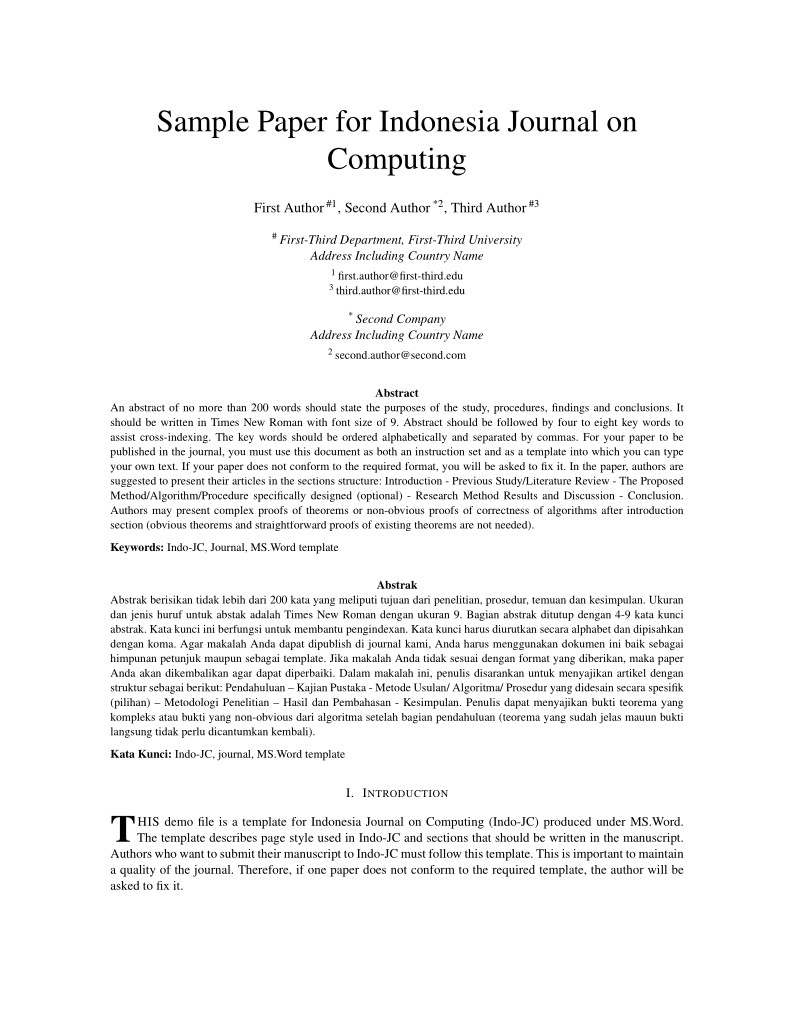
this is official template of Indonesian Journal on Computing (IndoJC)
%%
%% Template Indonesia Journal on Computing (Indo-JC) -- versi LaTeX
%% Kompilasi : pdflatex main.tex   (atau xelatex main.tex untuk Times New Roman asli)
%%
\documentclass{indojc}

\begin{document}

% ===========================================================================
%  BAGIAN DEPAN
% ===========================================================================
\jtitle{Sample Paper for Indonesia Journal on Computing}

\jauthors{First Author\,\textsuperscript{\#1}, Second Author\,\textsuperscript{*2},
          Third Author\,\textsuperscript{\#3}}

\jaffiliation{\textsuperscript{\#}\,\textit{First-Third Department, First-Third University}\\
              \textit{Address Including Country Name}}
\jgap[4pt]
\jemail{\textsuperscript{1}\,first.author@first-third.edu\\
        \textsuperscript{3}\,third.author@first-third.edu}
\jgap[10pt]
\jaffiliation{\textsuperscript{*}\,\textit{Second Company}\\
              \textit{Address Including Country Name}}
\jgap[4pt]
\jemail{\textsuperscript{2}\,second.author@second.com}

% ===========================================================================
%  ABSTRAK (Inggris)
% ===========================================================================
\begin{jabstract}[Abstract]
An abstract of no more than 200 words should state the purposes of the study,
procedures, findings and conclusions. It should be written in Times New Roman
with font size of 9. Abstract should be followed by four to eight key words to
assist cross-indexing. The key words should be ordered alphabetically and
separated by commas. For your paper to be published in the journal, you must use
this document as both an instruction set and as a template into which you can
type your own text. If your paper does not conform to the required format, you
will be asked to fix it. In the paper, authors are suggested to present their
articles in the sections structure: Introduction - Previous Study/Literature
Review - The Proposed Method/Algorithm/Procedure specifically designed
(optional) - Research Method Results and Discussion - Conclusion. Authors may
present complex proofs of theorems or non-obvious proofs of correctness of
algorithms after introduction section (obvious theorems and straightforward
proofs of existing theorems are not needed).
\end{jabstract}

\jkeywords[Keywords]{Indo-JC, Journal, MS.Word template}

% ===========================================================================
%  ABSTRAK (Indonesia)
% ===========================================================================
\begin{jabstract}[Abstrak]
Abstrak berisikan tidak lebih dari 200 kata yang meliputi tujuan dari penelitian,
prosedur, temuan dan kesimpulan. Ukuran dan jenis huruf untuk abstak adalah Times
New Roman dengan ukuran 9. Bagian abstrak ditutup dengan 4-9 kata kunci abstrak.
Kata kunci ini berfungsi untuk membantu pengindexan. Kata kunci harus diurutkan
secara alphabet dan dipisahkan dengan koma. Agar makalah Anda dapat dipublish di
journal kami, Anda harus menggunakan dokumen ini baik sebagai himpunan petunjuk
maupun sebagai template. Jika makalah Anda tidak sesuai dengan format yang
diberikan, maka paper Anda akan dikembalikan agar dapat diperbaiki. Dalam makalah
ini, penulis disarankan untuk menyajikan artikel dengan struktur sebagai berikut:
Pendahuluan -- Kajian Pustaka - Metode Usulan/ Algoritma/ Prosedur yang didesain
secara spesifik (pilihan) -- Metodologi Penelitian -- Hasil dan Pembahasan -
Kesimpulan. Penulis dapat menyajikan bukti teorema yang kompleks atau bukti yang
non-obvious dari algoritma setelah bagian pendahuluan (teorema yang sudah jelas
mauun bukti langsung tidak perlu dicantumkan kembali).
\end{jabstract}

\jkeywords[Kata Kunci]{Indo-JC, journal, MS.Word template}

% ===========================================================================
%  ISI
% ===========================================================================
\section{Introduction}

\jdropcap{T}{HIS}{ demo file is a template for Indonesia Journal on Computing
(Indo-JC) produced under MS.Word. The template describes page style used in
Indo-JC and sections that should be written in the manuscript. Authors who want
to submit their manuscript to Indo-JC must follow this template. This is
important to maintain a quality of the journal. Therefore, if one paper does not
conform to the required template, the author will be asked to fix it.}

\subsection{Content of Introduction Section}

In introduction, the context of the study and state the precise objective should
be explained. An Introduction should contain the following three parts:
background, the problem, and proposed solution. In explaining the background,
authors have to make clear what the context is. Ideally, authors should give an
idea of the state-of-the art of the field the report is about. The problem also
need to described clearly so that readers able to understand why they should
proceed reading. Authors also need to describe the proposed solution so that
readers able to point out what are the novel aspects of authors work. Authors
should place the paper in proper context by citing relevant papers.

\subsection{Page Layout and Style}

The manuscript must use a page size corresponding to US Letter which is 215.9mm
(8.5) wide and 279.4mm (11) long. The margins must be set: 30mm (1.18) for top,
30mm (1.18) for bottom, and 30mm (1.18) for each left and right margins. The
manuscript also must be in one column format. All paragraphs must be indented.
All paragraphs must be justified, i.e. both left-justified and right-justified.

Times New Roman or Times font should be used for the manuscript. Font size 10 is
used in general, except for title (24), author name (11), abstract (9), and
caption for figures and tables (8). More details on the font style used can be
seen in Table~\ref{tab:fontsize}.

\begin{table}[htbp]
  \centering
  \setlength{\tabcolsep}{5.4pt}
  \renewcommand{\arraystretch}{1.05}
  \caption{Font Size for Manuscripts}
  \label{tab:fontsize}
  \fontsize{9}{11}\selectfont
  \begin{tabular}{|L{22pt}|L{77.7pt}|L{43.2pt}|L{74.7pt}|}
    \hline
    \multirow{2}{22pt}{\centering\textbf{Front Size}} &
      \multicolumn{3}{c|}{\textbf{Appearance (in Times New Roman or Times)}} \\
    \cline{2-4}
     & \multicolumn{1}{c|}{\textbf{Regular}}
     & \multicolumn{1}{c|}{\textbf{Bold}}
     & \multicolumn{1}{c|}{\textbf{Italic}} \\
    \hline
    \multicolumn{1}{|c|}{8} & table caption (in Small Caps), figure caption,
      reference item & & reference item (partial) \\
    \hline
    \multicolumn{1}{|c|}{9} & author email address cell in a table
      & abstract body & abstract heading (also in Bold) \\
    \hline
    \multicolumn{1}{|c|}{10} & level-1 heading (in Small Caps), paragraph
      & & level-2 heading, level-3 heading, author afiliation \\
    \hline
    \multicolumn{1}{|c|}{11} & author name & & \\
    \hline
    \multicolumn{1}{|c|}{24} & Title & & \\
    \hline
  \end{tabular}
\end{table}

All title and author details must be in single-column format and must be
centered. Every word in a title must be capitalized except for short minor words
such as ``a'', ``an'', ``and'', ``as'', ``at'', ``by'', ``for'', ``from'',
``if'', ``in'', ``into'', ``on'', ``or'', ``of'', ``the'', ``to'', ``with''. To
avoid confusion, the family name must be written as the last part of each author
name (e.g. Mary J. Smith). Each affiliation must include, at the very least, the
name of the company and the name of the country where the author is based (e.g.
Telkom University, Indonesia).

For section headings, no more than 3 levels of headings should be used. All
headings must be in 10pt font. Every word in a heading must be capitalized except
for short minor words as listed above.

\subsubsection{Level-1 Heading}
A level-1 heading must be in Small Caps, centered and numbered using uppercase
Roman numerals. Please be noted that Acknowledgment and References are level-1
headings which must not be numbered.

\subsubsection{Level-2 Heading}
A level-2 heading must be in Italic, left-justified and numbered using an
uppercase alphabetic letter followed by a period.

\subsubsection{Level-3 Heading}
A level-3 heading must be indented, in Italic and numbered with an Arabic numeral
followed by a right parenthesis. The level-3 heading must end with a colon. The
body of the level-3 section immediately follows the level-3 heading in the same
paragraph. For example, this paragraph begins with a level-3 heading.

\subsection{Equation, Figures, and Tables}

Number equations consecutively with equation numbers in parentheses flush with
the right margin, as in~(\ref{eq:sim}). Be sure that the symbols in your equation
have been defined before the equation appears or immediately following.

\begin{equation}\label{eq:sim}
  S(N,K) = \frac{\sum_{i=1}^{n} w_{i} \times \sin\!\left(f_{N}, f_{K}\right)}
                {\sum_{i=1}^{n} w_{i}}
\end{equation}

Figures and tables must be centered in the column. Please check all figures in
your paper both on screen and on a black-and-white hardcopy. When you check your
paper on a black-and-white hardcopy, please ensure that: the colors used in each
figure contrast well, the image used in each figure is clear, and all text labels
in each figure are legible. Figures must be numbered using Arabic numerals.
Figure captions must be in 8 pt regular font. Captions of a single line must be
centered whereas multi-line captions must be justified. Captions with figure
numbers must be placed after their associated figures. Example of a figure can be
seen in Fig.~\ref{fig:example}.

\begin{figure}[htbp]
  \centering
  \includegraphics[width=2.3622in]{figure1.png}
  \caption{Example of a Figure}
  \label{fig:example}
\end{figure}

Tables must be numbered using uppercase Roman numerals. Table captions must be
centered and in 8 pt regular font with Small Caps. Every word in a table caption
must be capitalized except for short minor words as listed before. Captions with
table numbers must be placed before their associated tables, as shown in
Table~\ref{tab:fontsize}.

\subsection{Reference}

References are written using IEEE style as seen in the reference section in this
example file. Only for example, citation in the manuscript should be written like
this \cite{kopka1999}.

\section{Literature Review}

The aim of a literature review is to show the readers that authors have read, and
have a good grasp of, the main published work concerning a particular topic or
question in the field. It is very important to note that the review should not be
simply a description of what others have published in the form of a set of
summaries, but should take the form of a critical discussion, showing insight and
an awareness of differing arguments, theories and approaches. It should be a
synthesis and analysis of the relevant published work, linked at all times to
your own purpose and rationale.

\section{Research Method}

The presentation of the experimental methods should be clear and complete in
every detail facilitating reproducibility by other scientists.

\section{Results And Discussion}

The presentation of results should be simple and straightforward. This section
reports the most important findings, including results of statistical analysis as
appropriate and comparisons to other research results. Results given in figures
should not be repeated in tables. This is where Authors should explain in words
what he/she/they discovered in the research. It should be clearly laid out and in
a logical sequence. This section should be supported suitable references.

\section{Conclusion}

Summarize sentences the primary outcomes of the study in a paragraph. Explain if
the claims in this section supported by the results, and if they seem reasonable.
Also, describe whether the result support or contradict previous theories, and
explain how the research has moved the body of scientific knowledge forward.

% ---- Heading tanpa nomor -----------------------------------------------
\junnumbered{Acknowledgment}

The authors would like to thank\ldots

% ===========================================================================
%  DAFTAR PUSTAKA (gaya IEEE, 8pt)
% ===========================================================================
\begin{thebibliography}{9}

\bibitem{kopka1999}
H. Kopka and P. W. Daly, \textit{A Guide to LATEX, 3rd ed.} Harlow, England:
Addison-Wesley, 1999.

\bibitem{ref2}
J. K. Author, ``Title of chapter in the book,'' in \textit{Title of His Published
Book}, xth ed. City of Publisher, Country if not

\bibitem{ref3}
USA: Abbrev. of Publisher, year, ch. x, sec. x, pp. xxxxxx.

\bibitem{ref4}
Author. (year, month). Title. \textit{Journal. volume (issue),} pages. Available:
site/path/file

\bibitem{ref5}
J. K. Author, ``Title of paper,'' in \textit{Abbreviated Name of Conf.}, City of
Conf., Abbrev. State (if given), year, pp. xxxxxx.

\bibitem{ref6}
J. K. Author, ``Title of dissertation,'' Ph.D. dissertation, Abbrev. Dept.,
Abbrev. Univ., City of Univ., Abbrev. State, year.

\end{thebibliography}

\end{document}