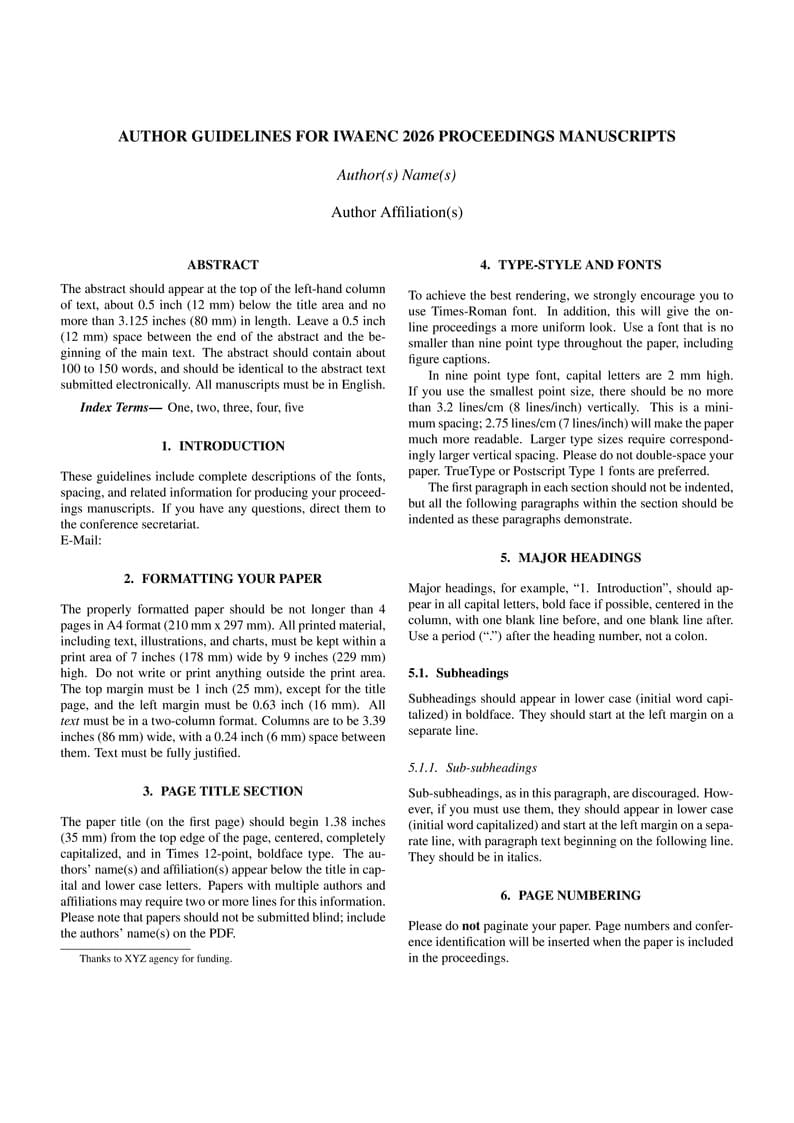
This template refers to the IWAENC 2026 conference. See https://iwaenc2026.org/.
% Template for IWAENC 2026 paper; to be used with:
%          spconf.sty  - ICASSP/ICIP LaTeX style file, and
%          IEEEbib.bst - IEEE bibliography style file.
% --------------------------------------------------------------------------
\documentclass{article}
\usepackage{spconfa4,amsmath,graphicx}

% Title.
% ------
\title{AUTHOR GUIDELINES FOR IWAENC 2026 PROCEEDINGS MANUSCRIPTS}
%
% Single address.
% ---------------
\name{Author(s) Name(s)\thanks{Thanks to XYZ agency for funding.}}
\address{Author Affiliation(s)}
%
% For example:
% ------------
%\address{School\\
%	Department\\
%	Address}
%
% Two addresses (uncomment and modify for two-address case).
% ----------------------------------------------------------
%\twoauthors
%  {A. Author-one, B. Author-two\sthanks{Thanks to XYZ agency for funding.}}
%	{School A-B\\
%	Department A-B\\
%	Address A-B}
%  {C. Author-three, D. Author-four\sthanks{The fourth author performed the work
%	while at ...}}
%	{School C-D\\
%	Department C-D\\
%	Address C-D}
%
\begin{document}
%\ninept
%
\maketitle
%
\begin{abstract}
The abstract should appear at the top of the left-hand column of text, about
0.5 inch (12 mm) below the title area and no more than 3.125 inches (80 mm) in
length.  Leave a 0.5 inch (12 mm) space between the end of the abstract and the
beginning of the main text.  The abstract should contain about 100 to 150
words, and should be identical to the abstract text submitted electronically.
All manuscripts must be in English.
\end{abstract}
%
\begin{keywords}
One, two, three, four, five
\end{keywords}
%
\section{Introduction}
\label{sec:intro}

These guidelines include complete descriptions of the fonts, spacing, and
related information for producing your proceedings manuscripts.
If you have any questions, direct them to the conference secretariat.\\
E-Mail:

\section{Formatting your paper}
\label{sec:format}

The properly formatted paper should be not longer than 4 pages in A4 format
(210 mm x 297 mm).  All printed material, including text, illustrations, and
charts, must be kept within a print area of 7 inches (178 mm) wide by 9 inches
(229 mm) high. Do not write or print anything outside the print area. The top
margin must be 1 inch (25 mm), except for the title page, and the left margin
must be 0.63 inch (16 mm).  All \textit{text} must be in a two-column format.
Columns are to be 3.39 inches (86 mm) wide, with a 0.24 inch (6 mm) space
between them. Text must be fully justified.

\section{Page Title Section}
\label{sec:pagestyle}

The paper title (on the first page) should begin 1.38 inches (35 mm) from the
top edge of the page, centered, completely capitalized, and in Times 12-point,
boldface type.  The authors' name(s) and affiliation(s) appear below the title
in capital and lower case letters.  Papers with multiple authors and
affiliations may require two or more lines for this information. Please note
that papers should not be submitted blind; include the authors' name(s) on the
PDF.

\section{Type-Style and Fonts}
\label{sec:typestyle}

To achieve the best rendering, we strongly encourage you to use Times-Roman
font.  In addition, this will give the online proceedings a more uniform look.
Use a font that is no smaller than nine point type throughout the paper,
including figure captions.

In nine point type font, capital letters are 2 mm high.  If you use the
smallest point size, there should be no more than 3.2 lines/cm (8 lines/inch)
vertically.  This is a minimum spacing; 2.75 lines/cm (7 lines/inch) will make
the paper much more readable.  Larger type sizes require correspondingly larger
vertical spacing.  Please do not double-space your paper.  TrueType or
Postscript Type 1 fonts are preferred.

The first paragraph in each section should not be indented, but all the
following paragraphs within the section should be indented as these paragraphs
demonstrate.

\section{Major Headings}
\label{sec:majhead}

Major headings, for example, ``1. Introduction'', should appear in all capital
letters, bold face if possible, centered in the column, with one blank line
before, and one blank line after. Use a period (``.'') after the heading number,
not a colon.

\subsection{Subheadings}
\label{ssec:subhead}

Subheadings should appear in lower case (initial word capitalized) in
boldface.  They should start at the left margin on a separate line.

\subsubsection{Sub-subheadings}
\label{sssec:subsubhead}

Sub-subheadings, as in this paragraph, are discouraged. However, if you
must use them, they should appear in lower case (initial word
capitalized) and start at the left margin on a separate line, with paragraph
text beginning on the following line.  They should be in italics.

\section{Page Numbering}
\label{sec:page}

Please do \textbf{not} paginate your paper.  Page numbers and conference
identification will be inserted when the paper is included in the proceedings.

\section{Illustrations, Graphs, and Photographs}
\label{sec:illust}

Illustrations must appear within the designated margins.  They may span the two
columns.  If possible, position illustrations at the top of columns, rather
than in the middle or at the bottom.  Caption and number every illustration.
All halftone illustrations must be clear black and white prints.  Colors may be
used, but they should be selected so as to be readable when printed on a
black-only printer.

\section{Footnotes}
\label{sec:foot}

Use footnotes sparingly (or not at all!) and place them at the bottom of the
column on the page on which they are referenced. Use Times 9-point type,
single-spaced. To help your readers, avoid using footnotes altogether and
include necessary peripheral observations in the text (within parentheses, if
you prefer, as in this sentence).

\section{References}
\label{sec:ref}

List and number all bibliographical references at the end of the paper.  The
references can be numbered in alphabetical order or in order of appearance in
the document.  When referring to them in the text, type the corresponding
reference number in square brackets as shown at the end of this sentence
\cite{Smith,Jones}.

% References should be produced using the bibtex program from suitable
% BiBTeX files (here: strings, refs, manuals). The IEEEbib.bst bibliography
% style file from IEEE produces unsorted bibliography list.
% -------------------------------------------------------------------------
\bibliographystyle{IEEEbib}
\bibliography{refs}

\end{document}